"Discrimination targets individuals and groups that are vulnerable to attack: the disabled, women and girls, the poor, migrants, minorities, and all those who are perceived as different ... But these victims of discrimination are not alone. The United Nations is standing with them, committed to defending the rights of all, and particularly the most vulnerable. That is our identity and our mission."[1]
Secretary-General Ban Ki-moon
The theme of International Human Rights Day 2009 is non-discrimination. As the 16 days of action series has shown, discrimination places women and girls at a higher risk of violence. That is, discrimination and the risk of violence are more acute when taking into consideration HIV and AIDS, poverty, ethnicity, sexual orientation, gender identity, disability, age, religion or creed, class, etc.
For the past 16 days, the Global Sisterhood has touched on various stories and issues related to Gender Violence and yet there is still so much left to say. It is important for us to acknowledge, also, the work being done every day by activists, both women and men, around the world to stop gender violence in their societies. Whether at the community level or the national level, these efforts are critical. They defend our human rights and often face threats, violence, and death for doing so. They remind us that ALL human beings have human rights and that when these rights are taken from us, we must resist.
The following piece was written by a very close friend in Vancouver. It speaks to many of the issues brought up in yesterday's post and presents other very important points. Lately, I have been thinking a lot about how we frame the role of men in violence and what we can do to improve this. The reason this is so critical is that if we don't address the ways in which gender violence is socialized, learned, and ascribed, we risk that we will continue to fight the same battle over and over again. I have much more to say on this issue, but I'd like to step aside for today and let someone else, whose opinion I highly respect and value, have her say.
On Violence Against Women by K. Darch
It has been twenty years since fourteen women were shot and killed by Marc Lépine at L’École Polytechnique in Montreal on Dec 6th, 1989. It’s now 2009, and former Secretary General of the United Nations, Kofi Annan, has said that violence against women is the most pervasive and destructive human rights violation facing the world today. I grew up post-Montreal massacre on a military base in Kingston, Ontario, with the prospect of voting and going to university, but daily life played out in an atmosphere of the constant threat of sexist violence from male peers. Like many people, I had the impression that the Montreal massacre was the random act of a mad man. I never heard that in his suicide note, Marc Lépine had a list of other well-known Canadian feminists, and I had never understood the event to be a politically motivated strike against an ideology that moves myself and other women closer to equality. The recent shootings at the LA Fitness Centre in Pennsylvania, the shooting of a mother, daughter and granddaughter by a husband in Alberta, and the murder by drowning of three teenage girls and their father's first wife in Kingston this summer preceded a similar response. The men were under financial pressure, they were racist, or they were “just plain crazy.” While these are often factors, what connects these killings is that in all of these instances it was women who were killed by men. To say the men are crazy is to exceptionalize them, in a world where violence against women is not the exception but the norm. On average, a woman is murdered in Canada every week at the hands of her intimate male partner - this year, more than 30 women have been killed by their intimate partners in Canada, and a record of 69 wives were murdered by husbands across Canada in 2007. In North America today, the amount of men killed in firefighting, policing, and in war is still five times less that the amount of women murdered by their spouses. Many of the perpetrators of male violence are fathers, husbands, roommates, and bosses. If they’re just bad apples, it seems that these apples are growing from the same tree. Twenty years later, we still live in a system of society and government in which men hold the power and women are largely excluded from it, and violence against women is the most harmful result of this power imbalance. Everyone needs to act, because in the city, in the country, globally, other social issues cannot be solved until we address women’s inequality. My limited understanding of the Montreal massacre and the fact that I didn’t link it to misogyny, or in any way to myself, shows how successful the general silencing about the aspect of misogyny in this event was - the same kind of silencing that women face when they speak out about their experiences with sexual assault and battery. What are some of the ways we can make systemic change? By fighting for a guaranteed livable income, better policing of violence against women, funding for women’s equality groups, and supporting women of colour formations worldwide. These conditions are transformable. We need to remember, but we also need to resist.
National Day of Remembrance and Action to End Violence Against Women
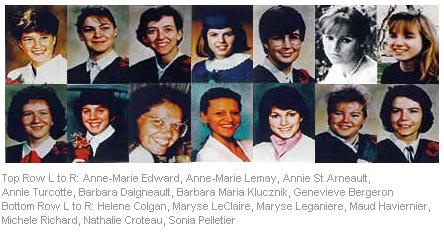
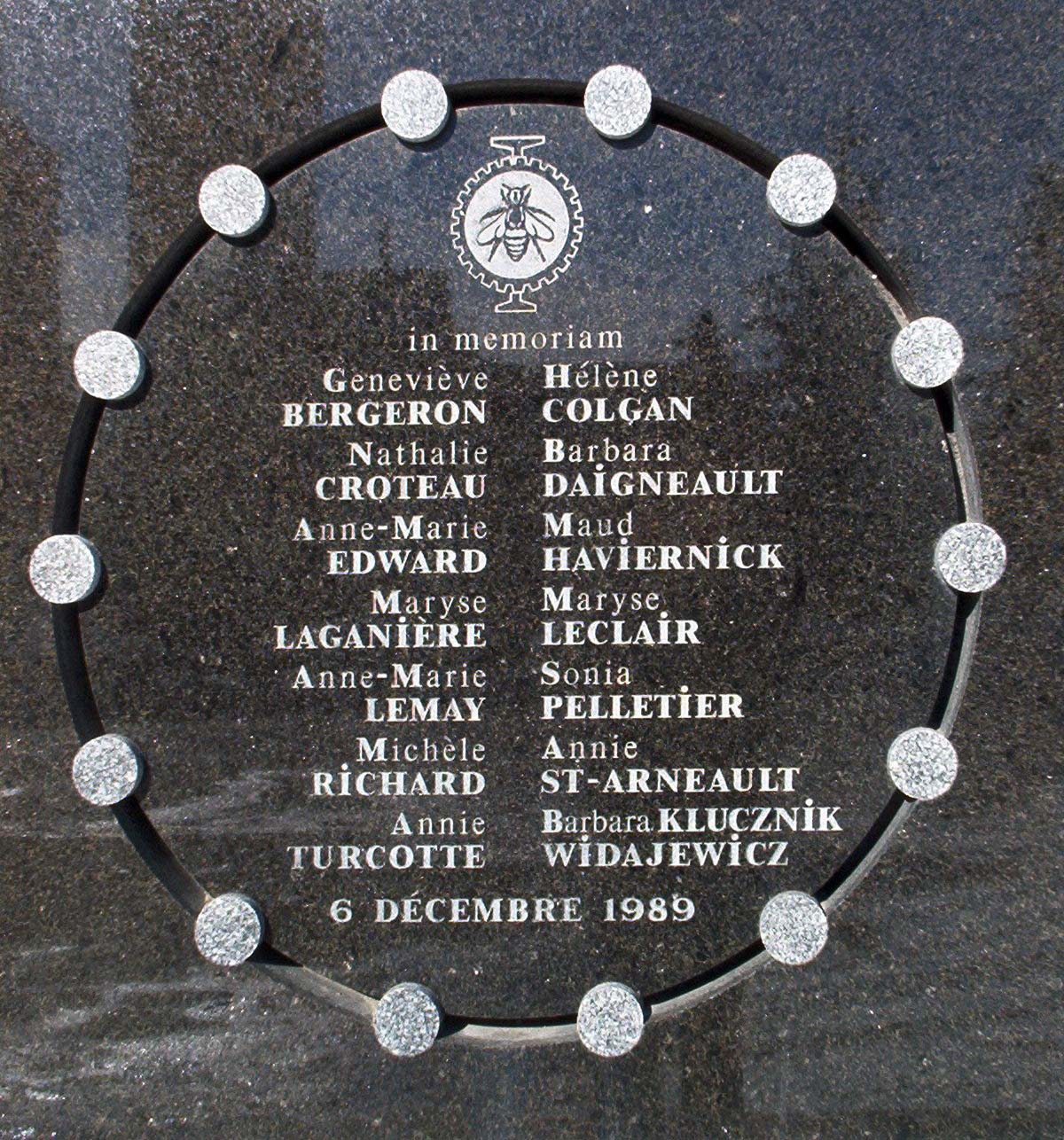
Over the past week I have read numerous articles and watched footage on the massacre of 14 women at L’École Polytechnique in Montreal on December 6, 1989. I have examined my own memories and feelings, and asked others to share their memories. Yesterday I spoke with my best friend and asked her about her memories of the Montreal massacre. Like me, she does not remember her reaction to the news on Dec. 6, 1989, but she does have a strong memory of the 10th anniversary and the profound impact it had on her. In 1999, she was studying mechanical engineering at Carleton University. She told me that as she read about the students killed at L’École Polytechnique she noticed how similar she was to them. Half of the women killed that day were mechanical engineering students. Many were preparing to graduate. She told told me: "It was so much more personal than just reading about these women. I realized it could have been me." In many of the interviews that I listened to today on CBC Radio One, journalists and other people on the scene that day remarked on the sense of disbelief that many people had. One journalist commented: "The shock sort of grew bigger when I found out that he had killed only women. I did not want to believe it. I was in total denial." In the hours, days, week, months and years that followed, the theme of disbelief and denial persisted. People insisted that it was a random act of violence by a madman, that it did not have a greater meaning or significance than this. Others, like the journalist quoted above, overcame the shock and realized that this was a targetted and premeditated attack against women. The fact that Marc Lépine did not personally know his victims is not the point; he murdered them because they were women studying in what was, at that time, a male dominated field. In the weeks prior to the shooting, he purchased a semi-automatic rifle and visited the school several times. At approximately 5:10pm on December 6, he interrupted a mechanical engineering class at L’École Polytechnique and ordered the women and men to separate to opposite sides of the classroom. At first, the students thought he was joking and no one moved. Lépine fired a shot in the air and ordered the approximately 50 men in the class to leave. Nine women remained. He asked them if they knew why they were there. One student replied 'no'. He told them he was fighting feminism. Natalie Provost, a student in the class, responded that they were not feminists. "We are just women who study engineering." Lépine replied "You're women, you're going to be engineers. You're all a bunch of feminists. I hate feminists," and he opened fire, killing six women and wounding three others [1]. Natalie Provost survived the attack. In a recent interview with the Globe and Mail, she was asked about what she said to Marc Lépine. here is what she had to say: "In 1989, feminism to me was a movement of women fighting to make sure women had the same rights as men. But as a woman, I never felt I needed to struggle; I believed doors were wide open for me. I used to see feminism as a conflict between men and women, but it's not that for me now. ... It's making sure women have an equal chance." [2] That Marc Lépine's chose to identify the female engineering students at L’École Polytechnique was not at all random. Attached to the suicide note he wrote was a list of 19 prominent women that Lépine identified as 'radical feminists' that he had intended to kill, but was not able to. Journalist, Francine Pelletier, was one of those women. I listened to her on CBC radio this morning. She said very interesting things about Marc Lépine, that I thought was worth sharing here: "It was not just women he was targetting. He was targetting progress." She also commented how the examiners and investigators determined that Marc Lépine "was not criminally insane". People may describe him as behaving 'zombie-like', 'deranged', and 'crazy', but that he had a clear motive and that he had devoted a great deal of thought to what he was doing is undeniable. In the words of Francine Pelletier: "It was hatred of women . . . It was hatred of feminists." And, as she also stated during her interview, "denying the meaning of this is as hurtful as what happened that day." I have to agree. Denying that this was an act of hatred and violence against women and against feminism, against progress, is like saying that those women died for no reason, that their deaths were random. Marc Lépine's crime was not random. When I asked friends for their memories of December 6, 1989, a friend in Vancouver collected an observation from her friend and a former collective member of Vancouver Rape Relief and Women's Shelter, Erin Graham. She said: "I remember that night so clearly. When we heard it, we were on the third floor, having our weekly meeting about how to run the crisis line. We knew, from the moment we heard of it, that this man had made a political statement against feminists, and that this was about all of us. All of us. And yet, with each passing year, no matter what we did, it seemed that sand sifted over the politic, until it has disappeared from view. Except for those of us who were there, young women now, like you, see these attacks, and are told, over and over, "no, no, it's just that one guy, over there--" and the story disappears in the shifting sands of trivia we're told is news." I think this relates to what Francine Pelletier's comments about the meaning of that day and other comments related to the sense of denial that I spoke of earlier. I think there's a lot of truth there, especially when it comes to the larger picture of violence against women and girls. It brings to mind the crisis of missing and murdered aboriginal women and the number of women killed every year by their husbands and male partners in Canada. It also makes me think about the proposed elimination of the long gun registry in Canada and how political will too often seems to take precedence over the safety of people. There's so much more to say about this day, its significance and how it speaks to the larger issue of violence against women in my country, but I think that I will draw this post to a close now with some information about each of the women that were murdered 20 years ago today, followed by a clip of CBC news coverage from December 6, 1989. The following information was obtained from CBC News online. Geneviève Bergeron, 21, was a second-year scholarship student in civil engineering. She played the clarinet and sang in a professional choir. In her spare time she played basketball and swam. Hélène Colgan, 23, was in her final year of mechanical engineering and planned to do her master's degree. She had three job offers and was leaning towards accepting one from a company based near Toronto. Nathalie Croteau, 23, another graduating mechanical engineer, planned to take a two-week vacation in Cancun, Mexico, with Colgan at the end of the month. Barbara Daigneault, 22, was to graduate at the end of the year. She was a teaching assistant for her father Pierre Daigneault, a mechanical engineering professor with the city's other French-language engineering school at the University of Quebec at Montreal. Anne-Marie Edward, 21. She loved outdoor sports like skiing, diving and riding and was always surrounded with friends. Maud Haviernick, 29, was a second-year student in engineering materials, a branch of metallurgy, and a graduate in environmental design from the University of Quebec at Montreal. Barbara Maria Klucznik, 31, the oldest of the victims, was a first-year nursing student. She arrived in Montreal from Poland with her husband in 1987. Maryse Laganière, 25, of Montreal, was the only non-student killed. She worked in the budget department of the engineering school. She had recently married. Maryse Leclair, 23, in fourth-year metallurgy, had a year to go before graduation and was one of the top students in the school. She acted in plays in junior college. She was the first victim whose name was known and she was found by her father, Montreal police Lieut. Pierre Leclair. Anne-Marie Lemay, 27, of Montreal, was in fourth-year mechanical engineering. Sonia Pelletier, 28, was the head of her class and the pride of St-Ulric, Que., her remote birthplace in the Gaspe peninsula. She had five sisters and two brothers. She was killed the day before she was to graduate with a degree in mechanical engineering. She had a job interview lined up for the following week. Michèle Richard, 21, of Montreal, was in second-year engineering materials. She was presenting a paper with Haviernick when she was killed. Annie St-Arneault, 23, a mechanical engineering student from La Tuque, Que., a Laurentian pulp and paper town in the upper St-Maurice river valley, lived in a small apartment in Montreal. Her friends considered her a fine student. She was killed as she sat listening to a presentation in her last class before graduation. She had a job interview with Alcan Aluminium scheduled for the following day. She had talked about eventually getting married to the man who had been her boyfriend since she was a teenager. Annie Turcotte, 21, of Granby, Que., was in her first year and lived with her brother in a small apartment near the university. She was described as gentle and athletic - she was a diver and a swimmer. She went into engineering so she could one day help improve the environment. --------- CBC Archives: The Montreal Massacre, 1989 [English]
Archives Radio-Canada: Tragédie à l'école Polytechnique [French / Français]
National Day of Remembrance and Action on Violence Against Women
The fourteen women, pictured above, were murdered at L' École Polytechnique on December 6, 1989. Most of them were students going about their day, attending classes and studying. Their lives were stolen from them by a 25 year old man, Marc Lépine. He claimed that he was "fighting feminism", but what he was really doing was committing a horrible act of gender violence.
Today I will be posting links, articles, thoughts, comments, and video clips about December 6, 1989 and how we remember this day.
December 6th is a National Day of Remembrance and Action on Violence Against Women in Canada because, 20 years ago on this day, 14 women, engineering students, were murdered at at L’École Polytechnique in Montreal. This weekend, people across Canada will gather to remember their murder and other women who have been targets of violence. Tomorrow I will attend a memorial vigil that, I hope, will be widely attended by many others. We may think, and hope, that something like this could never happen again, that women's presence in all academic programs and disciplines, as well as fields and careers, is accepted. In many ways, women have achieved acceptance, but in other ways we are still the targets of violence in our schools, workplaces, and homes. Sexual violence, sexual harassment, and intimate partner violence remain serious threats to the health, well-being, and lives of many girls and women. In 2008, Amnesty International released Safe Schools: Every Girl’s Right, a report on violence against girls in and out of school and the violation of the right to education. The report indicates that, in many cases, girls face violence in and around their schools. Nor do these risks cease once they enter university. Although many universities across Canada now have in place security measures for preventing sexual assaults and rape on campus, attacks against female students remain a problem. I recall a case of a brutal sexual assault of a female student on the campus of Carleton University in August 2007. The 23-year old student was working in one of the university's chemistry labs when her attacker, described as a white male in his 20s, entered the lab, beat the young woman unconscious, and sexually assaulted her. I also think, given that many cases of rape are not reported, that incidents of sexual assault and rape on university campuses is much higher than we are aware. Looking back on the murder of 14 female students at L’École Polytechnique in Montreal 20 years ago, we may want to tell ourselves that women and girls no longer face violence in schools or in the workplace, that things have changed. While it is true that some of us are safer, many girls and women face violence every day - at school, at work, and at home - and we have a duty to address this crisis and strengthen our efforts to end violence.
I decided to take a day off to think about some issues that I've been muddling over during the past week and plan articles/pieces for the rest of the series. In the meantime, here are some articles and videos that I have benefited from reading over the past week, and others from my collection of bookmarked links on gender and violence. I will be back again tomorrow with another entry for the 16 Days of Activism series. If you have anything you'd like me to add, links to website or articles that you recommend, please post a comment and let me know. Ruined by “too much” education by Delta Ndou: A very interesting and quotable opinion piece from columnist Delta Ndou in Zimbabwe on GBV and how gender roles and heterosexist attitudes contribute to the perpetuation of intimate partner violence. Although she never uses the term heterosexist, I think it is an accurate way of describing pejorative notions about 'educated women'. Pambazuka News. 16 Days of Activism against Gender Violence: Features a collection testemonies from survivors of violence and a series of articles on GBV. The "I" Stories, in particular, are very moving and shine a spotlight into the lives of women who suffered and escaped from violence. Amnesty International. Protecting Individuals at Risk: Features cases of human rights defenders, activists, and journalists at risk. I was particularly drawn to the story of human rights defender Justine Masika Bihamba in the Democratic Republic of Congo. Justine and her family have been targeted by soldiers for her work as the "coordinator of a women's human Rights organization, Synergy of Women Against Sexual Violence (SFVS)." The New York Times. A Man's World: A video addressing the situation of widows in Afghanistan. Includes enlightening and moving interviews with widows living in a shelter run by the Red Crescent society. The Independent. Taliban murder leading Afghan female rights activist: An article about the murder of human right's activist Sitara Achakzai in Kandahar, Afghanistan in April of this year. Achakzai "was instrumental in organizing a nationwide sit-in of more than 11,000 women, in seven provinces. The women ‘prayed for peace’ to mark International Women’s Day. " At the tie of her murder, she was planning to leave Afghanistan for some time, fearing for her safety. The tragic story of her death reminds me of the risks that many human rights defenders face in carrying out their work. Toronto Sun. Women's haven like living 'in hell': Tenants at a YWCA apartment building that provides housing for abused women claim that conditions in the building are not safe such that they, and their children, face "physical attacks, death threats, vandalism and fear." The article highlights a serious issue for organizations that provide services to victims.
For many people in the West, the term slavery brings to mind the trans-Atlantic slave trade and the enslavement of Africans in the United States. This is the most common representation of slavery seen in the mainstream media and it portrays an important period in human history which many people consider to have ended with the abolition of the slavery in the United States in 1865 [1]. What many people do not realize is that slavery has continued to exist in many parts of the world, including countries such as Canada, the United States, Britain, and many European nations. Although slavery is illegal, it is still practised through forced labour, worst forms of child labour, and human trafficking, including sex trafficking. Recently, police in Calgary, Alberta arrested and laid charges in two separate human trafficking cases.
Modern Slavery
"Forced labour takes different forms, including debt bondage, trafficking and other forms of modern slavery. The victims are the most vulnerable – women and girls forced into prostitution, migrants trapped in debt bondage, and sweatshop or farm workers kept there by clearly illegal tactics and paid little or nothing." [2]
- International Labour Organization
The International Labour Organization (ILO) estimates that at least 12.3 million people are victims of forced labour [3]. Other organizations, such as Free the Slaves and the Coalition to Abolish Slavery and Trafficking, place the total number of enslaved persons in the world today at around 27 million [4]. Women and children are especially vulnerable to modern forms of slavery, in particular human trafficking and sexual slavery, largely as a result of poverty. In particular, gender inequalities and discrimination increase the vulnerability of women and girls to trafficking because of attitudes that view them as the 'property' of men and also as a result of their lack of access to education and employment opportunities.
Many organizations around the world are working with, or without (in some cases), governments to end slavery and rescue victims of human trafficking. Individuals also have a role to play by informing authorities about suspected cases of trafficking. For more information on human trafficking in Canada, visit the RCMP's Frequently Asked Questions on Human Trafficking or the Department of Justice page on human trafficking. Another factor to consider is informing organizations that advocate for the rights of illegal immigrants and refugees, such as No One is Illegal, to ensure that rights of victims of human trafficking are respected and that they do not face deportation. We ALL have a role to play in ending modern forms of slavery. Watch, look, listen, educate (yourself and others) and support Fair Trade.
The Call + Response trailer may be a good place for people unfamiliar with modern slavery to start. Sources
December 1st is World AIDS Day. UNAIDS estimates that there are approximately 33.4 million people living with HIV in the world (2008) [1]. Women represent 50% of the number of adults living with HIV and often experience the impact of HIV more severely than men [2]. Women and girls are at greater risk of contracting HIV than men not only as a result of a greater biological susceptibility to the virus, but also because of gender inequalities. Women and girls often lack educational and economic opportunities, which increases their dependence on men and can decrease their involvement in decisions that have a direct impact on their health and well-being. Social and economic dependence can also limit their power to refuse sex or insist on condom use [3]. Additionally, lack of access to education and information, as well as the impact of illiteracy, mean that women and girls are often unaware of how to "protect themselves against HIV or other sexually transmitted infections, which can increase the risk of contracting HIV/AIDS" [4]. Gender violence also makes women and girls more vulnerable to contracting HIV. Women in abusive relationships are less likely to insist their partners use condoms or to refuse sex for fear of violence. Women who do refuse sex are often beaten and raped by their partners and may receive little to no support from their extended family, their communities, and the police. In many societies, the notion of 'conjugal rights' includes the 'duty' of a spouse to honour their partner's 'right' to sex and the concept of marital rape is rejected as a foreign construct. Support services provided for victims of sexual and other forms of violence, through women's centres and health care facilities, play a pivotal role in treating, assisting and counselling women. Unfortunately, these services are not always available in the areas where they are needed most and, in cases where they are available, service providers may face resistance, threats, or violence from within the communities in which they work.
For more more information, facts, and figures on HIV and AIDS visit: www.unaids.org Sexual Violence and Conflict “In no other area is our collective failure to ensure effective protection for civilians more apparent — and by its very nature more shameful — than in terms of the masses of women and girls, but also boys and men, whose lives are destroyed each year by sexual violence perpetrated in conflict.” United Nations Secretary-General, Ban Ki-moon, 2007 (S/2007/643) [5] Sexual violence in conflict contributes to the spread of HIV among women and girls and has devastated the lives of thousands of women and their families. Rape is used as a weapon of war to "shame and demoralize women, tear communities apart, and control populations" [6]. Women and girls are brutalized in front of their families and communities, forced to witness the brutalization and murder of their loved ones, and taken by combatants to be used as 'sex slaves'. During the 1994 genocide in Rwanda, between 250'000 and 500'000 women and girls were raped [7] and it is estimated that, of those who survived the genocide, 70% have been infected with HIV [8]. More women and girls are raped every day in conflict zones, such as South Kivu in the Democratic Republic of the Congo and Darfur, Sudan [9]. Those who are infected with HIV face challenges in gaining access to counselling, treatment, and anti-retroviral (ARV) medications. Increasingly, the United Nations, in collaboration with other organizations and governments around the world, are taking steps to address, respond to, and prevent sexual and other forms of violence during conflict and peace time. Since 2000, the United Nations Security Council has enacted three resolutions that address issues related to women, peace, security, sexual violence and conflict (Resolutions 1325, 1820, and 1888) [10]. It is hoped that these measures, in conjunction with other actions such as the inter-agency initiative UN Action Against Sexual Violence in Conflict (UN Action), will help to fill a long standing gap in the ways in which the UN and member states have responded to conflicts and increase the involvement of women in the peace process. However, much more remains to be done to address the gender inequalities and attitudes which continue to place women and girls at risk of violence, HIV and AIDS both during times of peace and war. For more more information on sexual violence in conflict, visit the following sites:
Adolescent and pre-adolescent girls are particularly vulnerable to violence, including sexual violence, due to their position in society. Gender inequalities and under-valuing of female children means that girls are often denied their rights to life, security, education, health care, adequate nutrition, and protection from all forms of violence, neglect. Girls are more often denied the right to education, which substantially limits their opportunities for advancement and entrenches their economic dependence on others for support in adulthood.
Sexual, emotional, and physical violence against girls affects their development and sense of well-being. It can destroy the bonds of trust within families and have a drastic impact on future relationships. In some cases, parents and other family members are responsible for violence against girls or are complicit in violence. 'Honour killings', child marriage, child trafficking, physical and sexual abuse, FGC/FGM (female gentital cutting/mutilation), and others are forms of violence, or expose children to violence, that commonly involve family members. The remaining portion of this article will highlight the problem of child marriage.
Child Marriage
"A girl came to our area after she got married to her husband. When she refused to have sex with him, he beat her up. Then my parents and some other people intervened. After that, she ran away in the middle of the night to her parents and said to them that she wants to go to school. But, since they refused to send her to school, they married her again. Then she hanged herself … She didn't want that [marriage], but we don't have a choice." Amhara girl (Ethiopia), age 15, married at age 4 [1]
"Child marriage is a violation of human rights whether it happens to a girl or a boy, but it represents perhaps the most prevalent form of sexual abuse and exploitation of girls. The harmful consequences include separation from family and friends, lack of freedom to interact with peers and participate in community activities, and decreased opportunities for education. Child marriage can also result in bonded labour or enslavement, commercial sexual exploitation and violence against the victims. Because they cannot abstain from sex or insist on condom use, child brides are often exposed to such serious health risks as premature pregnancy, sexually transmitted infections and, increasingly, HIV/AIDS." [2]
- Child Protection Information Sheet, UNICEF -
Child marriage can be defined as the "marriage of anyone below the age of 18. It is the marriage of a child to an adult or another child, and may be legally condoned by national laws." [3] As the above quotes demonstrate, child marriage disproportionately affects girls and has severe consequences for their health, happiness, development, and well-being. Girls are often subjected to violence by their own families when they refuse to marry or when they run away from their husbands. Whether or not a child can 'agree' to marry is a subject of some debate. Whereas some may argue that an adolescent is capable of consenting to marry before the age of 18, the majority of child marriage cases do not involve free, full and informed consent and can therefore be considered 'forced'. In the majority of child marriage cases girls are prevented from completing their schooling. They also are more likely to experience early childbearing, which exposes young girls to maternal mortality and obstetric fistula. Despite the fact that most countries have signed the UN Convention on the Rights of the Child and have specified 18 as the minimum legal age for marriage, child marriage continues to be a problem in many countries.
Where does it happen?
"The practice of girls marrying at a young age is most common in sub-Saharan Africa and South Asia. However, in the Middle East, North Africa and other parts of Asia, marriage at, or shortly after, puberty is common among some groups.
There are also parts of West and Eastern Africa and South Asia where marriages much earlier than puberty are not unusual. The marriage of girls between the ages of 16 and 18 is common in parts of Latin America and Eastern Europe.
It is hard to know the number of early marriages as so many are unregistered and unofficial." [4]
Why does it happen?
In societies where child marriage persists, the rights of women and girls are not respected. Women and girls are frequently viewed as inferior and are not allowed to make decisions about their own lives, including decisions about when and who they should marry. Child marriage might take place between families "as a means of maintaining or ensuring social, economic or political ties between families . . . [or] Parents may consent to child marriages out of economic necessity." [5] Whereas child marriage is always a violation of children's rights, parents and family members may not view the practice as a human rights issue. Rather, it is bound up in notions of tradition, honour, and kinship.
What is being done?
Programs and projects which sensitize communities and families to the negative impacts of child marriage, encourage girl-child education, and provide access to income generating opportunities for families and women, are helping to change attitudes and reduce the prevalence of child marriage. United Nations and international development agencies work with NGOs and grassroots organizations to address factors that entrench child marriage, such as poverty, gender inequalities, violence against women and girls, sexism, and other related issues. Empowering women and girls and working with communities, families, and individuals is making a difference in the lives of many girls. It is also important for victims to be able to share their stories.
Too Brief a Child
"This 13-minute video examines the impact of early marriage on the lives of girls using testimonies from teenage brides and their families in Bangladesh, Burkina Faso and Yemen." UNFPA
Sources
[1], [3], [4], [5] Child Rights Information Network. 19 July 2007 - CRINMAIL 899 - Special edition on child marriage.
http://www.crin.org/email/crinmail_detail.asp?crinmailID=2280
November 29 is the International Day for Women Human Rights Defenders. Launched in 2005 at the International Consultation on Women Human Rights Defenders in Sri Lanka as part of the 16 days of Activism against Gender violence, this day pays tribute to women human rights defenders, the work they do, and the risks they face in defending human rights. [1]
Their vocal presence in the male-dominated political and public realm of life, and their resistance to gender norms that restrict and violate their rights to political participation and association, place their lives at risk. Every day, women around the world face violence and threats for speaking out against human rights violations. In the remaining portion of this post I will highlight the stories of women human rights defenders as well as provide links to additional information on their work and how we can support their efforts.
The Global Sisterhood recognizes and highly values the work of these brave women and expresses solidarity with their efforts. We must support their efforts and do what we can to allow them to continue their work. I would like to add that, in addition to the women honoured in this post, thousands of women around the world are at risk of violence because they defend human rights. Whether they are lawyers investigating cases of human rights violations by governments, politicians in parliament fighting corruption and impunity, community health workers who support victims of violence, or one girl demanding her right to pursue an education, women who demand respect for their human rights and the rights of others deserve our support and respect.
Malalai Joya - Afghanistan
Recently, the United Nations identified Afghanistan as the "worst place in the world to be born." [2] The UN indicated that Afghanistan has the "highest infant mortality rate in the world -- 257 deaths per 1,000 live births, and 70 percent of the population lacks access to clean water." [3] Children's right to education is also at risk, with "317 schools in Afghanistan . . . attacked in the past year, killing 124 and wounding another 290" [4], with evidence that girls' schools are being particularly targeted for attacks. The human rights situation for women in Afghanistan is also dire. Even though women now hold seats in parliament, "violence against women [has remained] endemic [and] women in public life are regularly threatened, and several have been assassinated." [5]
Malalai Joya is one of the most widely known women human rights defenders that brings attention to the daily struggles of Afghani citizens to survive. As a delegate from Farah Province at the Loya Jurga Constitutional Assembly in 2003, she spoke out against the presence and involvement of warlords at the Assembly and stated, "They oppress women and have ruined our country. They should be prosecuted. They might be forgiven by the Afghan people, but not by history." For these honest and brave comments, she was banished from the assembly.
In 2005, Malalai Joya became the youngest person to be elected to the parliament in Afghanistan. Two years later, in May 2007, she was suspended from parliament for her criticism that the Afghani parliament was ineffective and not helping the Afghani people. [6] She has "survived at least four assassination attempts, and has been called the bravest woman in Afghanistan, where she still lives." [7] While in Afghanistan, she travels under the protection of armed guards and wears a burqa to keep from being recognized. She is a vocal opponent of President Hamid Karzai, recently re-elected in widely critized elections in Afghanistan this Fall, and a strong defender of women's human rights in her country.
Ms. Joya recently concluded a intercontinental book tour for her memoir "A Women Among Warlords", co-authored by Canadian writer Derreck O'Keefe. On November 26, she spoke in Ottawa, Canada, to a large group of people at Centretown United Church. When she spoke, she brought to the attention of her listeners the struggles of her people, in particular women and children. She talked about the thousands of civilians that have been killed since the U.S., Canada, and Britain sent troops to Afghanistan. She condemned the involvement of 'criminals, warlords, and druglords' in the Afghan parliament and spoke out passionately against the impunity afforded to perpetrators of sexual violence against women in Afghanistan. Ms. Joya also called for the withdrawal of foreign, including Canadian, troops from her country and stated that her country needs an "invasion of schools," not military forces.
What I found truly striking about her was that she hardly spoke about her own struggles and experiences; rather, she made it clear from the start that she considered herself only one woman among many who are struggling for peace and justice in Afghanistan. She is devoted to speaking out against injustices in her country even though it places her safety and life at risk. In a recent interview with the Globe and Mail she was asked, given the "attempts on your life . . . [and threats] to beat you and rape you for saying what you are saying. Are you afraid?" She replied "I fear political silence. I do not fear death." [8] Malalai Joya is one of the many Women Human Rights Defenders that this day pays tribute to. The Global Sisterhood honours and admires her determination and commitment to justice.
Rita Mahato - Nepal
Rita Mahato works with the Women's Rehabilitation Centre (WOREC) to investigate and document "cases of sexual violence against women, and provides health and legal support to victims." [9] Investigating and documenting incidents of domestic and sexual violence and pressuring the police to arrest prepetrators has placed Rita and her colleagues at the WOREC at considerable risks. They pursue their work in a context where other defenders of women's human rights have been murdered for carrying out similar work. WOREC workers like Rita face discrimination as well as rape and death threats. In June 2007, the WOREC offices were attacked when "20 people threw bricks at the . . . office for two hours." [10] Despite the intimidation and threats, Rita and her colleagues at WOREC continue to investigate and document cases of sexual violence and speak out against violations of women's rights in their communities. To find out how you can write to Rita and her colleagues, as well as the Inspector General if Police in Nepal to urge for the protection of WOREC staff and an investigation into the attacks and threats against them, visit Amnesty International Canada's 'Write for Rights' website by clicking here. Past Amnesty International letter writing campaigns have helped to protect other human rights defenders, free political prisoners, and save lives.
Natalia Estemirova - Russia and Chechnya
On July 15, 2009, human rights defender Natalia Estemirova was abducted and murdered. Estemirova and her colleagues at the Russian human rights NGO Memorial in Grozny, Chechnya, investigated and documented human rights violations in Chechnya, "such as torture and other ill-treatment, unlawful killings and enforced disappearances, since the start of the second Chechnya war in 2000." [11] In an interview with Amnesty International in 2008, Estemirova stated "if you are a true human rights activist you are constantly violating the unwritten laws created by the Russian Government." [12]
Estemirova was aware that the work she and her colleagues at Memorial engaged in placed them at considerable risk. During an acceptance speech for a Human Rights Defender award she received from Human Rights Watch in 2007 she said that "in Chechnya, the government creates an atmosphere of fear and mistrust. Those who witness abuse keep silent, for if they speak they can soon become a victim." [13] She recognized the importance of their work and the role it played in fighting for justice for victims of human rights violations and ending government impunity. Natalia Estemirova's murder illustrates the risk that human rights defenders face every day for the work they carry out. To date, no one has been charged with her murder. Less than a month after the abduction and murder of Estemirova, Zarema Sadulayeva, head of the charity Save the Generations, and husband Alik Dzhabrailov were abducted and murdered in Grozny, Chechnya. [14]
Like many North American girls, I grew up with little understanding of what the term 'feminism' meant. When I did hear the term, it was commonly associated with 'bra burning' and 'radical' behaviour and these were not portrayed as 'good' or 'appropriate' things for women to do. I did gain a minimal understanding of the importance of feminism to the Women's Movement of the 1960s and 70s and to the notion and understanding of women's rights that we now have today; however, for the most part, feminism was something I did not really understand. I look back now and I can clearly see that I was suffering from the effects of the backlash against feminism and the women's movement that was part and parcel of growing up in the 1980s, and which remains with us up to the today.
As time passed, I became more conscious of terms like "gender equity", "equality", "discrimination", and "violence against women." In high school I wrote a paper for my law class about violence against women in Canada based on the 1993 Statistics Canada Violence Against Women Survey . I wore a button with a red rose on it, in memory of the 14 women murdered in 1989 at L'École Polytechnique by misogynist and anti-feminist Marc Lepine, in what came to be known as the Montreal Massacre. In university, I studied approaches to feminism and feminist political philosophy, learned more about women's historical exclusion from the public/political realm, and examined notions of gender equality and women's human rights. I learned to understand, embrace, and identify with the term 'feminism'.
Having come to a point in my life where I am proud to call myself a feminist, I find myself unnerved and somewhat surprised to still encounter negative attitudes towards feminism. In the last several months, I have been unsettled by the realization that feminism is still a very misunderstood concept and, in many cases, considered 'a dirty word'. Go ahead, call yourself or a woman close to you a feminist and see what happens. You might be pleasantly surprised or baffled, depending on the person, time, and place. Some months ago I was speaking to a friend and she told me how she said something along the lines of "well, we're all feminists here" at her women's book club and was shocked to find that no one else seemed to want to be associated with this term.
Recently, I was listening to an interview on the radio in which a young man was talking about his efforts to confront the issue of violence against women with his peers. I was interested to hear about his experiences and was glad to hear about the efforts being made to address this critically important issue. There came a point in the interview where he expressed the concern that men were being 'left out' of actions and efforts to end violence against women and when asked why he thought this was the case he responded that he thought it was because of "overzealous feminism". The moment I heard those words I felt a surge of disappointment. I also felt very annoyed and frustrated. It seemed to taint everything he had said up until that point in the interview. I wasn't so much mad at the young man as frustrated that, yet again, I was confronted with yet another example of how pervasive misconceptions about feminism remain. I wrote down the man's name in my notebook and considered tracking down his email address online. I wasn't sure what I was going to say, but I knew I had to say something.
Later that day, I carried out a search online and found the man's email address. With some insight from a friend in mind, I drafted and sent the following email. I don't know if he got the email, since I have yet to receive a response, but knowing that I was making an effort to re-claim feminism, from the negative misconceptions that so often surround it, helped to ease some of my discomfort. I remain committed to opposing negative, false, and harmful notions about feminism when and where I encounter them. If you have some thoughts or experiences to share on this matter, please post a comment to this entry and have your say. And so, without further delay, here is my response to the term 'overzealous feminism':
Dear ***,
I am writing in response to a comment you made on CHUO this morning about the role men should have in ending violence against women. To begin with, I would like to commend you and your peers on your efforts to address this critical issue. We all have a role to play in addressing and ending gender violence. I hope that you will continue to discuss this issue with your colleagues, peers, family, and friends as well as different communities within the National Capital Region and beyond.
This having been said, you expressed the concern that "overzealous feminism" prevents or restricts men's involvement in efforts to end violence against women. These were not your exact words and if my interpretation is incorrect, please let me know. I would like to invite you to clarify what you meant by "overzealous feminism" and also take this opportunity to suggest why even well meaning men may face restrictions related to their involvement in certain aspects of opposing gender violence. I would also like to tell you why the term 'overzealous feminism' could be considered offensive.
Let me begin by telling you that I was deeply concerned and troubled by your use of the expression 'overzealous feminism' and the context in which you used it. I spoke with a friend this afternoon who works at the Sexual Assault Centre in Ottawa and asked for her thoughts on the issue. She explained that men's involvement may be restricted because of the role that patriarchy and oppression play in perpetuating violence against women.
It is a fact that, by and large, men (not all men, but generally speaking) are frequently the perpetrators in cases of violence against women and girls. A woman or a girl who has experienced violence may then, understandably, not feel safe or comfortable around men, regardless of whether or not they were directly involved in the violence she experienced. Additionally, women and girls are often targets of violence and sexual assault simply because they are female. As such, violence against women and girls is directly related to discrimination against them based on their gender.
Gender inequalities and discrimination against women and girls mean that they are often regarded as inferior to men and boys and they are subjected to violence when they attempt to assert their human rights. In many communities all over the world, women and girls are not encouraged to take leadership roles or demand their rights and when they do they are subjected to threats and violence or murdered.
While men can, should, and are, more and more, involved in efforts to end violence against women and girls, they must be sensitive to the context in which gender violence occurs and this may mean that they cannot always be directly involved in all actions. This is not because of 'overzealous feminism', it is because of the history of oppression and the realities of gender violence. Women and girls must be the leaders in this movement and men and boys can and should support them in appropriate and sensitive ways. This means respecting that some spaces and events are for "women only" and not being offended by this. When these types of decisions are made by women's support groups, they are not the acts of 'overzealous feminists' and do not imply that all men are perpetrators of violence. Rather, these decisions are made by and for women that have suffered acts of violence and discrimination and show respect for their needs.
Last, but not least, I would like to emphasize that although women and girls are entitled to the same human rights as men and boys, gender inequalities persist to marginalize women and girls everywhere, even in Canada. Feminism is about women's efforts, throughout history up to the present, to secure gender equality, justice, and their fundamental human rights. Terms like 'overzealous feminism' degrade and rob a powerful, meaningful, and empowering term of its dignity and perpetuate a harmful stereotype about feminism and its role in securing our rights. When I say that I am a feminist I should not have to fear people thinking negative things about me. I hope that you understand why this is so important and sympathize with my point of view.
If you would like to discuss this issue further, feel free to contact me at this address. Once again, thank you for your interest and efforts to address and stop gender violence and for speaking out about this issue publicly.
Over the next two weeks, the Global Sisterhood will be writing about a different aspect of gender violence in an effort to highlight this multifaceted and critically important topic and to increase my own awareness, as well as that of others. I will also be writing in recognition of the 16 Days of Activism against Gender Violence, an international campaign marked by organizations and groups of concerned citizens all over the world.
Background
The 16 Days of Activism campaign was conceived in 1991 at the first Women's Global Leadership Institute conference, sponsored by the Center for Women's Global Leadership. The dates, November 25 – December 10, were chosen by participants to emphasize the link between “violence against women and human rights and to emphasize that such violence is a violation of human rights.” [1] In addition to the International Day for the Elimination of Violence Against Women (Nov. 25) and International Human Rights Day (Dec. 10), the 16 Days also bring attention to other important dates, such as International Women Human Rights Defenders Day (Nov. 29), World AIDS Day (Dec. 1) and the anniversary of the Montreal Massacre (Dec. 6). Since 1991, thousands of organizations in hundreds of countries have participated in the 16 Days Campaign, reflecting the fact that Gender Violence is a global concern that requires global attention and activism. Each year, the campaign has highlighted a theme, from "Democracy without Women's Human Rights . . . is not Democracy" (1993) to "For the Health of Women, For the Health of the World: No More Violence," (2004-2005). This year, the theme is Commit ▪ Act ▪ Demand: We CAN End Violence Against Women!
Why the Global Sisterhood is blogging about Gender Violence
This year’s theme for the 16 Days meets one of the Global Sisterhood’s central tenets: SOLIDARITY. On Day 1, I wrote to the Prime Minister of Canada, asking him to take action on violence against women and noted that up to 70%, or 1 in 3, women worldwide will experience violence during her lifetime. This means that most women have experienced or will experience violence directly. It also means that all of us, whether are we are aware of this fact or not, know someone who has, is currently, or will experience gender based violence. I cannot speak for others, but I can say that, for me, knowing someone who has experienced violence has a profound effect on me. It affects me in the sense that I feel upset and angry that a friend was subjected to violence, but also because there is an awareness that ‘if it could happen to you, it could happen to me’. It means that, to varying degrees, all women live with a sense of insecurity (i.e. lack of security, not lack of self-esteem), the feeling that we may be at risk of violence. We may feel it when we are walking somewhere, alone, late at night or entering a poorly lit entrance way or stairwell. And yet there is the reality that many women face violence from people they know. All of which is to say that we are all affected by violence, in some way or other.
About Gender
It is also important to note that when we speak of gender violence, we are referring to not only to women, but also girls and persons who face violence in relation to their gender identity, such transgendered, two-spirited, intersex, or queer persons. Gay, lesbian, and bisexual persons also face violence based on the ways in which others perceive them as subverting so-called gender norms or roles. Stereotypical ideas that exclusively associate ‘manhood’ and ‘womanhood’ with heterosexuality mean that people who do not conform to these notions are at risk of oppression and violence. Whereas men and boys are also victims of violence, women and girls are more likely to experience specific forms of violence specifically because of their gender. Women and girls are also more vulnerable to violence due to gender inequalities and discrimination against them based on their gender. Lack of access to education, illiteracy, lower wages, lack of economic opportunities, patriarchal attitudes, oppressive gender norms and roles, sexism, heterosexism, and other related factors all place women and girls at a greater risk of violence.
Solidarity and Sisterhood
Much more must be done to if we are to eliminate gender violence. Significant gains in many parts of the world have been made; however, the laws and policies put into place to protect us have not brought an end to gender based violence. In some cases, it is laws and policies that further entrench and condone gender based violence, such as a law recently passed in Afghanistan which “gives a husband the right to withdraw basic maintenance from his wife, including food, if she refuses to obey his sexual demands” [2], among other extremely oppressive measures. In a world where millions have access to technology that increases our capacity to obtain and transmit information, we have the power to support one another in the struggle for truly universal, equality, and dignity. And with this power, comes the responsibility to act. When we turn our backs on the pain and suffering of others, we turn our backs on our own humanity, on our capacities to become better than we are, to learn and to grow. I believe that we not only CAN achieve change, but that we MUST act together to end gender violence. We owe it to ourselves, our sisters, and our brothers to take a stand against gender violence today.
Over the next two weeks, the Global Sisterhood will address various aspects of gender violence, including:
Violence against girls, forced and early marriage
Violence against women and girls with disabilities
Activism against gender violence: International Women Human Rights Defenders Day
Violence against women with disabilities
Gender violence, HIV and AIDS, and sexual violence and conflict (rape as a weapon of war)
The National Day of Remembrance and Actionto End Violence Against Women(Dec. 6)
Human Trafficking
If you have any suggestions, comments, links, articles, ideas, or thoughts to share, please leave a comment and I will get back to you as soon as possible. If you would like me to post an article you wrote or a link to an event or action, please let me know. Thank you and I hope to hear from you soon.